The Ultimate Method to Calculate and Optimize Airbnb Profitability
Airbnb profitability is the net result after cleaning, commissions, taxes and maintenance, projected on a conservative 65% occupancy; a good net yield sits between 8% and 15%. This guide gives the method, from market data tools to nightly-rate estimation, with my Angers apartment as the example: 520 euros a month long-term, estimated 15,000 to 20,000 a year on Airbnb.

Ready to boost your Airbnb revenue?
Automate guest communication and earn more 5-star reviews with our AI assistant.
Get started free1# Understand Your Goal: Maximizing Revenue
The primary goal of short-term rentals is to maximize revenue, which often involves more property management work and more time dedicated to the short-term rental business as a whole.
Keep in mind that while the revenue potential is higher, it requires rigorous management.
2# Use Data Aggregation Tools
One of the essential resources I use to evaluate the Airbnb rental market is a short-term rental market data platform.
These platforms aggregate data from short-term rental listings (primarily those published on Airbnb). For a specific city or geographic area, they provide various indicators such as average nightly rate, occupancy rates, and potential revenue… In short, a goldmine for making informed decisions!
Simply enter a city into the tool to get a comprehensive overview of key indicators, including a market score based on demand, revenue growth, seasonality, and regulations.
For example, here is the information I obtained for my property (a one-bedroom apartment) located in the city of Angers, France: a favorable market score, with potential annual revenue of 17,800 euros and an occupancy rate of 66%.
3# Analyze Key Airbnb Profitability Indicators
The average nightly rate in Angers is 78 euros, but this figure can fluctuate depending on the season. It is essential to understand these fluctuations to optimize your pricing strategy.
These tools also provide a metric called RevPAR (Revenue Per Available Room), which offers a realistic view of revenue by taking into account the length of stays.
Market data platforms let you filter results by property type, number of bedrooms, and other criteria. For my analysis, I focused on one-bedroom apartments, which gives a clearer picture of what to expect for my property type. This segmentation helps set realistic expectations and make objective, data-driven decisions.
4# Calculating My Airbnb Profitability
Once you have your data in hand, it is time to move to the most important step: calculating Airbnb profitability. I use a rental yield simulator, which helps evaluate the overall viability of the project. Here is what to enter in it:
- Property Details: Enter the purchase price, renovation costs, and floor area. For my property in Angers, the purchase price was 130,000 euros with 5,000 euros in renovation costs for a 32 sqm apartment.
- Revenue Projections: Based on market data, enter the annual revenue. For example, in my situation, a conservative estimate would be 16,000 euros per year.
- Expenses: Include ALL relevant expenses such as management fees, utilities, insurance, and other operational costs (cleaning, internet…). For short-term rentals, these expenses are generally higher than for long-term rentals. My estimated annual expenses amount to approximately 5,400 euros.
- Financing: Include mortgage details if applicable. For a 20-year loan at a 3.7% interest rate, the monthly payment can significantly impact your cash flow.
And there you have it: your rental yield is calculated automatically!
Here is a video tutorial of what I just explained:
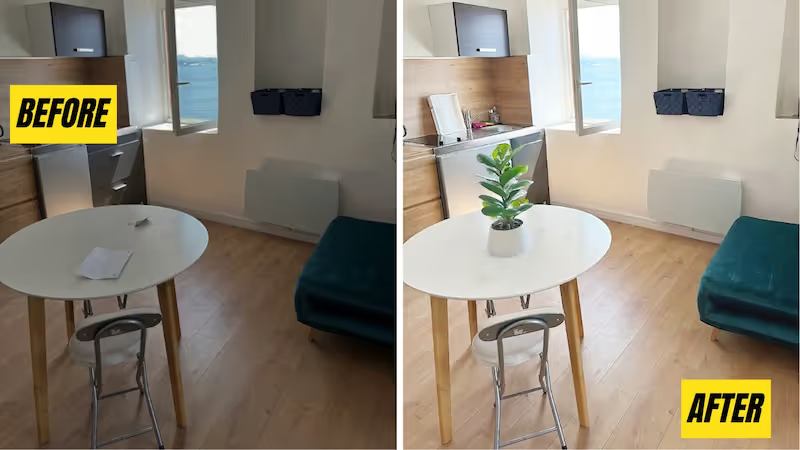
Long-term rental vs Airbnb: my Angers apartment before and after
The apartment in this example is a 32 sqm one-bedroom in Angers that I have owned since 2007. I bought it for about 81,000 euros and it is worth about 130,000 euros today, the value I use in the simulator above. For years I let it long term to students and young workers, and it was the least profitable property in my portfolio:
- Low rent: even after rising from 400 to 520 euros a month, it brought in at most about 6,240 euros a year.
- A layout that limits long-term tenants: a 32 sqm one-bedroom is hard to rent to a couple and even harder as a flatshare, which capped the rent.
- Tax on a small income: the rent was taxed, which cut the return further (see our guide to Airbnb taxes).
I switched it to short-term rental for four reasons:
- Manageable local rules: at the time, Angers had fewer restrictions than Paris or Bordeaux. Rules change quickly (France’s Le Meur law of November 2024 gave cities new tools to regulate short-term rentals), so check your own city before you switch.
- A layout that suits travelers: with a sofa bed in the living room, the apartment sleeps up to four.
- Flexibility: without a long lease, I can take the apartment back to sell it or to host family.
- Much higher income potential: estimated at 15,000 to 20,000 euros a year, against 520 euros a month as a long-term let.
The switch takes money and time up front. Here is what I did:
- Renovation: painting, a new made-to-measure kitchenette and new bathroom furniture.
- Furniture and decor: durable, good-looking pieces rather than the cheapest options (sofa bed, double bed, desk, bar stools, tableware, bed and bath linen), plus rugs, frames, plants and throws.
- Automation: systems to automate check-in, checkout and cleaning, to keep management time and costs down. This took me the longest, and it is what tip 1 below is about.
5# Optimize Your Airbnb Profitability
To maximize your earnings, consider implementing dynamic pricing using a specialist tool. These tools adjust your nightly rates based on market demand, competitor pricing, and other factors, ensuring you get the best possible rate for each booking. If your rental is connected to Nowistay’s channel manager, its built-in AI Pricing does this without a separate tool: included in the AI Channel Manager subscription, it suggests a price for every free night with the reason for each change, never below the minimum price you set, and you apply it in one click.
Dynamic pricing is one lever among several. Once your numbers are set, these are the ones that move income the most:
- An optimized listing: professional photos, a clear title and a complete description are the first things guests judge (see how to rank higher on Airbnb).
- More channels: listing on Booking.com and Vrbo as well as Airbnb, through a channel manager that keeps one calendar, fills nights a single platform would leave empty.
- Fewer empty gaps: accept shorter stays in quiet periods and offer weekly or monthly discounts to attract longer ones.
- Lower running costs: automation cuts management time and cleaning coordination, which raises net profitability, not just revenue.
- Regular reviews of your metrics: occupancy rate, average nightly rate, RevPAR and review scores, compared month by month with the market data from step 2.
Should you hand everything to a property manager instead? It makes sense if you lack time or manage several properties, but their commission comes out of your revenue, so compare it with what automation would cost you (see how much co-hosts charge).
6# My 4 Tips for Managing Your Short-Term Rental
- Automate your processes: Automate as much as possible! This is my most important piece of advice. From guest communication to check-in and check-out, using tools like smart locks and automated messaging systems, you will save a tremendous amount of time and effort. Personally, I would say I have managed to automate my Airbnb up to 95%. And I am still looking for ways to handle the remaining 5%!
- Professional cleaning: Ensure a high standard of cleanliness by hiring professional cleaning services. And do not skimp on your cleaner’s pay. This not only improves guest satisfaction but also ensures a consistent experience.
- Quality amenities: Invest in high-quality amenities. Offering features like high-speed internet, Netflix, and a well-equipped kitchen can significantly enhance the guest experience and justify higher nightly rates.
- Marketing and guest reviews: Encourage guests to leave positive reviews by providing exceptional service. Positive reviews significantly increase your listing’s visibility and make it more attractive on short-term rental platforms like Airbnb and Booking.
Short-term rentals can be a very profitable business if approached with the right strategies and tools. By using market data aggregation tools, dynamic pricing tools, and comprehensive profitability calculators, you can make informed decisions that maximize your rental income. Remember, the key to success in this market is rigorous management, continuous optimization, and a focus on delivering exceptional guest experiences.
Frequently asked questions
How do you calculate Airbnb profitability?
Gross profitability is calculated by dividing annual rental income by the purchase price, multiplied by 100. For net profitability, deduct all expenses (cleaning, insurance, taxes, maintenance, platform commissions). A good net yield for an Airbnb typically ranges between 8% and 15%.
What expenses should you factor into Airbnb profitability?
Expenses to include are platform commissions (3-15%), cleaning between each stay, non-occupant owner insurance, co-ownership charges, property tax, maintenance and furniture replacement, internet and energy subscriptions, and income taxes on rental revenue.
What occupancy rate should you expect for a profitable Airbnb?
A realistic occupancy rate for a well-managed Airbnb ranges between 60% and 80% depending on location and seasonality. In tourist areas, it can reach 85-90% during peak season. For your financial projections, use a conservative 65% rate for the first year.
How to estimate the average nightly rate for your Airbnb?
To estimate your average nightly rate, analyze similar listings in your area on Airbnb and Booking.com. Market data and dynamic pricing tools provide precise market figures. Factor in seasonality, local events, and your property quality.
Is an Airbnb investment more profitable than long-term rental?
Airbnb can generate 2 to 3 times more revenue than long-term rental, but expenses are also higher. Net profitability depends on location, occupancy rate, and management. In tourist areas, Airbnb is often more profitable; in low-tourism areas, traditional rental may be preferable.
How can I increase my Airbnb income?
Work on several levers together: an optimized listing (photos, title, description), dynamic pricing with a minimum price that covers your costs, more channels (Booking.com and Vrbo as well as Airbnb) through a channel manager, fewer empty gaps (shorter minimum stays in quiet periods, long-stay discounts), and automation to cut running costs. Review occupancy, nightly rate and reviews every month.
How can I reduce vacancy on Airbnb?
List on several platforms through a channel manager, accept shorter stays in quiet periods to fill gaps, offer weekly and monthly discounts, and improve your position in Airbnb search results with better photos, a complete listing and fast replies.
Is it worth switching a long-term rental to Airbnb?
Often, if local rules allow it and the property suits travelers. In my Angers example, a one-bedroom let at 520 euros a month has an estimated short-term potential of 15,000 to 20,000 euros a year. Short-term rental costs more to run (cleaning, furniture, management time) and needs more work, so compare net profitability, not gross income.
Maximize your rental income!
Our digital welcome guide + AI assistant help you deliver unforgettable stays.
Try it free
Bassel Abedi

Founder & CEO of Nowistay
Over 25 years of experience in real estate investing, and an Airbnb Superhost who runs his own vacation rentals with Nowistay. Bassel helps property managers increase revenue, cut operating costs, and deliver 5-star guest experiences using AI-powered tools he built from firsthand hosting experience.