Dynamic pricing on Airbnb: AI at the service of hosts
AI dynamic pricing adjusts your Airbnb rates night by night from demand, seasonality, events and competitor prices, so you stop guessing and fill gaps at the right price. This guide explains how it works, how to choose a tool, the mistakes to avoid, and how Nowistay's built-in AI Pricing sets one price for every channel, with PriceLabs as an alternative.

Maximize revenue with smarter pricing and automation
Sign up free. AI Pricing built in (or PriceLabs if you prefer), one price for every channel, direct booking engine: all in one platform.
Start free trialThe challenges of Airbnb pricing: a balancing act
Let’s talk frankly. Setting the right price on Airbnb is a bit like walking a tightrope. Too high, and nobody clicks on your listing. Too low, and you feel like you’re selling your property short while wondering if you’re not coming across as a low-quality option.
Claire, a host for three years in Lyon (France) confided: “At first, I was changing my prices every two days. I’d watch what others were doing, compare, stress out. And in the end, I was wasting tons of time for mediocre results.”
This is exactly where dynamic pricing comes in. Instead of fixing a single rate that never really matches market reality, it allows you to automatically adjust your property’s price based on dozens of variables. Demand explodes before a festival? Your price goes up. A slow week in November? It drops to stay attractive.
The goal is simple on paper, but complex in practice: sell each night at the best possible price, without missing opportunities.
In a market where guests compare many listings before booking, being at the right price at the right time makes all the difference.
How does dynamic pricing actually work?
Concretely, dynamic pricing is like having a market analyst working for you 24/7. Except that instead of a human who sleeps at night and takes weekends off, it’s an algorithm that never stops.
The basic principle is relatively simple: your rate evolves automatically based on what’s happening in the market. But behind this apparent simplicity lies a sophisticated mechanism.
The factors the algorithm continuously analyzes
Imagine an electronic brain constantly observing dozens of signals:
- Local demand comes first. If everyone is looking for accommodation in your neighborhood the same weekend, prices naturally climb. It’s the law of supply and demand, but applied in real-time and with surgical precision.
- Seasonality obviously plays a major role. School holidays, long weekends, festival periods… all these moments when demand explodes are anticipated by the algorithm. But not just national events: even a local marathon or professional trade show in your city will be taken into account.
- Your booking history also allows the AI to learn. If your property systematically fills up three weeks in advance in summer, but stays empty until the last minute in winter, the algorithm adjusts its strategy accordingly.
- Competition is closely monitored. The rates of properties similar to yours, their occupancy rates, their new listings… everything is analyzed to position you intelligently in the market.
- Finally, your property’s specific characteristics come into play: size, amenities (that Nespresso machine and private parking count!), precise location, reviews left by previous guests. An apartment with an ocean view and 4.9 stars obviously won’t play in the same league as a windowless studio rated 3.5.
AI and real-time adjustment: the real revolution
What really changes the game today is these AI systems’ instant reaction capability (especially on Airbnb).
Let’s take a concrete example. A big Beyoncé concert is announced in your city three months from now. Instantly, the algorithm detects the event, estimates the influx of visitors, analyzes available accommodation capacity, and adjusts your rate in a few minutes. No need to wait until you stumble upon the news by chance.
Conversely, imagine a storm is forecast for next weekend and several travelers cancel. The AI notices immediately and slightly lowers your rates to attract the few people still looking for accommodation, rather than leaving your apartment empty.
Thomas, who manages three properties in Bordeaux (France), explained: “Before, I had empty nights that I could have easily rented for $50 instead of $80. Now, the algorithm does it on its own. I no longer miss those opportunities.”
No human can maintain this permanent reactivity. Even the most conscientious host won’t check their rates every hour.
Have a look at: AI Airbnb: How artificial intelligence is revolutionizing vacation rentals in 2026
Concrete benefits for hosts and travelers
Let’s talk results. Because beyond the technology, what matters is the impact on your bank account and on travelers’ experience.
For hosts: optimized revenue and less stress
Hosts who adopt dynamic pricing often see their annual revenue rise, mainly because they stop underpricing their busiest dates. Even a modest gain adds up to a meaningful amount over a year.
But beyond the numbers, there’s the gain in time and peace of mind. No more evenings comparing competitors’ prices, hesitating between $75 and $82, wondering if you should have lowered your price earlier.
Sophie, a host in Nice (France), sums it up well: “Now, I focus on what really matters: welcoming my guests, maintaining the property, the little touches. Prices are no longer my problem. And paradoxically, I earn more.”
Occupancy rates also improve. During slow periods, the algorithm offers attractive rates that continue to attract travelers rather than leaving your property empty out of pride.
For travelers: more accuracy and transparency
You might think only hosts benefit. In reality, travelers also benefit from this more fluid market logic.
Rates become fairer because they reflect actual demand. A Tuesday night in November logically costs less than a Saturday night in July. It’s normal, and travelers accept it.
Available inventory stays broader too. When hosts optimize their revenue, they’re less tempted to remove their properties from the platform. Price flexibility maintains the attractiveness of the offering.
Finally, transparency improves. Price fluctuations are no longer perceived as arbitrary or unfair, but as a logical reflection of supply and demand at a given moment.
Tools to take action right now
Concretely, how do you implement this dynamic pricing? Several solutions are available, from the simplest to the most sophisticated: Airbnb’s own tool, external pricing tools, and dynamic pricing built into your PMS, such as Nowistay’s AI Pricing.
Smart Pricing: Airbnb’s built-in tool
Airbnb offers its own system called Smart Pricing. It’s free, already integrated into your interface (Airbnb Help Center), and does the job for beginners. The tool automatically adjusts your rates according to market trends.
The problem? It remains fairly basic and often too cautious. Many experienced hosts find it too conservative, missing opportunities to maximize revenue.
External tools for dynamic pricing: more power and control
To go further, several third-party solutions leverage AI more extensively:
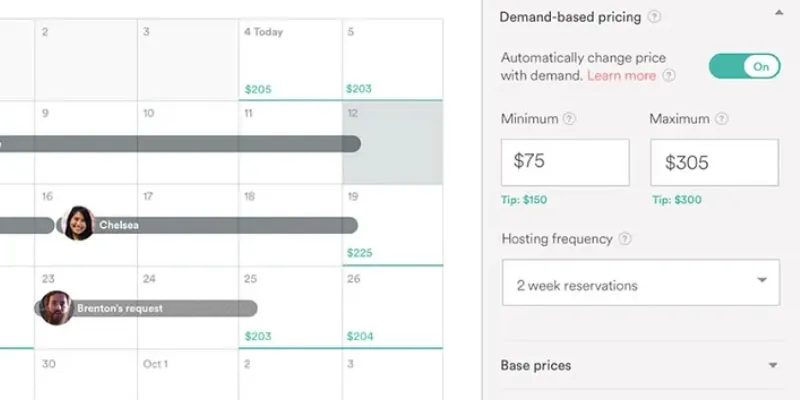
- Comprehensive dynamic pricing tools analyze local demand, upcoming events, and direct competition. You set minimum and maximum limits (because no, even AI won’t rent your apartment for $20), and the system does the rest.
- Education-focused pricing tools go beyond automatic adjustment and explain why each rate is recommended. They’re ideal for gradually understanding market mechanisms and refining your own strategy.
- Scale-oriented pricing platforms are particularly suitable for managers of multiple properties. They automate adjustments at scale while integrating hyper-local data. If you manage five or more apartments, they’re an option to seriously consider.
- Market analysis platforms take a different approach. They’re not really automatic pricing tools, but rather ultra-detailed market research platforms. You’ll find average occupancy rates by neighborhood, prices charged by your competitors, seasonal trends… Perfect for adjusting your long-term strategy or deciding if investing in a particular neighborhood is profitable.
How to choose the right dynamic pricing tool
The right tool is the one that fits your portfolio and the way you work, not the one with the longest feature list. Check these points before you commit:
- Your real need. Do you want fully automatic prices, recommendations that explain each rate, or market data to guide your own decisions? A host with one studio and a manager with twenty listings will not pick the same tool.
- Compatibility with your setup. The tool must connect to the PMS or channel manager that holds your calendar, so the same prices reach every platform where you are listed. A tool that only updates Airbnb leaves your other channels behind.
- Control settings. Look for minimum and maximum prices, weekday and weekend rules, minimum stay settings, last-minute and far-out adjustments, and date overrides for events you know about.
- Data for your market. Algorithms need comparable listings. In a small or very seasonal market, check that the tool has enough data around you to price sensibly.
- Free trial and support. Test the tool on your own calendar before paying, and see how quickly support answers when a price looks wrong.
- Cost. Pricing models vary (a monthly fee per listing or a share of your revenue). Compare that cost with the extra revenue you can realistically expect on your property.
Using a dynamic pricing tool with your PMS
If you are listed on several platforms, connect the pricing tool to your PMS rather than to each platform separately. The tool calculates your prices and sends them to the PMS, and the channel manager pushes the same rates and restrictions to Airbnb, Booking.com, Vrbo and Expedia. You keep one source of truth for prices and avoid gaps between channels.
Three habits make this setup work:
- Change prices in the pricing tool. Once prices sync automatically, the tool usually overwrites rates edited by hand elsewhere at its next sync. Adjust the base, minimum or maximum price in the tool instead.
- Know the sync rhythm. Many tools recalculate and push prices once a day, with a manual sync button for urgent changes. Prices are not updated minute by minute.
- Sync more than the nightly rate. Minimum stays and check-in or check-out restrictions can also come from the tool, which helps fill short gaps between bookings.
Nowistay AI Pricing: dynamic pricing built into your PMS
If your calendar runs in Nowistay, you don’t need to connect a separate tool. AI Pricing is Nowistay’s built-in dynamic pricing, included in the AI Channel Manager plan at no extra cost. It suggests a nightly price for every free night over the next 2 years, gives the reason behind each change, and sends applied prices to every connected channel. In the app, you find it under AI Pricing in the left menu, just below Calendars.
How AI Pricing sets your prices
Every suggestion starts from three settings you choose for each property:
- Typical price: your default nightly price, roughly your average over the year. AI Pricing moves each night up or down around it but never changes it on its own, so your prices don’t drift.
- Minimum price: AI Pricing never suggests a lower price.
- Quality: below average, average or above average compared with similar homes nearby. An above-average home gets smaller discounts, a below-average home deeper ones to fill its free nights.
From there, AI Pricing follows about 20 similar homes near yours and combines, night by night:
- Season, weekends and peaks: how the prices of similar homes nearby change over the year and around each night.
- Demand: the share of those homes that are no longer available that night, compared with what is usual. When many more homes than usual are taken, your price goes up.
- Holidays and local events: public and school holidays for your area, and the name of the concert, fair or festival that explains a peak. An event name never changes a price by itself: the demand does.
- Last-minute nights: a night still free a few days before arrival gets a gradual discount, up to 15% for an average home (10% above average, 20% below average), and its minimum stay can drop to 1 night. There is no last-minute discount when demand is high, or when your Airbnb last-minute discount already covers the night.
- Orphan nights: 1 to 3 free nights between two bookings in the next 60 days get a price 15% lower and a minimum stay shortened to fit, so they can sell. More ideas in our guide to filling gap nights.
- Your own rules: instructions written in plain words, such as “Never below €90 on weekends”, come first.
Suggestions or Automatic: you choose how much to delegate
- Suggestions mode (the default): AI Pricing prepares a proposal for each property. You check the price curve, open Review nights and click Why? to see how much each factor moved a price, then apply the whole proposal in one click. Any update can be undone for 14 days.
- Automatic mode (opt-in, property by property): AI Pricing applies its proposal every morning at 07:00, property time. Prices move step by step (at most +30% or -20% in one morning). Unlike most external tools, it never overwrites a price you set yourself in the calendar: those nights show Priced by you and stay as they are. Every update can be undone for 14 days, and Automatic pauses when there is too little market data.
The safeguards
- Never below your minimum price, and never above 3 times your typical price on its own.
- Prices only go down for nights in the next 60 days that are not selling. Orphan nights are the exception.
- Small differences are not proposed: a change must be at least 8% and at least €5.
- Keep my price holds a run of nights at your price: they are not proposed again for 14 days, unless the market moves by 10% or more.
- Prices are calculated from market data, so the same data always gives the same price. AI reads your written instructions and names local events, but it never sets a price by itself.
Applied prices are written to your Nowistay calendar and sent to Airbnb, Booking.com, Vrbo, Expedia, Agoda and your direct booking website. Per-channel rate adjustments, such as +15% on Airbnb, stay on top, and the suggested price excludes the cleaning fee and taxes.
Who can use it
AI Pricing works for properties connected to Nowistay PMS, Nowistay’s channel manager, on the AI Channel Manager plan. It prices single units: multi-unit properties are not supported yet. A property whose prices are managed by PriceLabs keeps PriceLabs until you switch it.
Prefer PriceLabs? It is still available
PriceLabs remains available as an integration, with its own subscription billed by PriceLabs. Each property uses one or the other. You generate a key in Nowistay, import your listings into PriceLabs and turn on its daily price sync: PriceLabs can then update rates, minimum stays and check-in or check-out restrictions, and Nowistay sends them to your connected channels. If you later want to move a property to AI Pricing, you switch it in one click from the AI Pricing page.
Step-by-step guides:
- AI Pricing: how Nowistay sets your nightly prices
- AI Pricing: review and apply your price suggestions
- AI Pricing Automatic mode: prices updated every morning
- How to connect PriceLabs for dynamic pricing
- How to manage your availability and prices from the calendar?
Common dynamic pricing mistakes to avoid
A dynamic pricing tool is powerful, but it is only as good as its settings. These are the mistakes hosts make most often:
- Setting it and forgetting it. Algorithms can misfire after a configuration error or a sudden market change. Look at your upcoming prices at least once a week.
- Trusting the algorithm on local events. A tool may miss that a trade show moved to another city or that roadworks block your street this summer. Add date overrides for what you know and the algorithm does not.
- No floor price. Without a minimum that covers cleaning, utilities and commissions, a quiet week can produce nights that cost you money.
- One logic for the whole year. Weekdays and weekends, high and low seasons, short and long stays do not behave the same way. Use the tool’s day-of-week and seasonal settings.
- Changing the base price every few days. Give the algorithm a few weeks of booking data before judging it, and adjust the base price in small steps. New listings and markets with little data take longer to settle.
- Mixing manual and automatic changes. Editing prices by hand on one platform while a tool syncs the others creates inconsistent rates. Keep one place where prices are set.
Does dynamic pricing work if your season is the reverse of most markets?
If your town is quiet in summer and full for autumn festivals, dynamic pricing still works: most pricing tools learn seasonality from demand in your own market, not from a fixed summer peak. PriceLabs, for example, says its algorithm already accounts for your market’s seasonality and advises replacing it with your own seasons only when you really need to. Where local data is thin, because few comparable listings exist or events change dates every year, set three things by hand: event dates with a higher price and a longer minimum stay, a minimum price that keeps your quiet season profitable, and a weekly look at the months ahead. In Nowistay’s AI Pricing, the season comes from how the prices of similar homes nearby change over the year, and you can add event dates as written instructions, for example “+20% during the festival, 7 to 26 July 2027” (minimum stays are set in the calendar).
Toward ever more intelligent pricing
Dynamic pricing isn’t a recent invention. Airlines have been using it since the 1980s, hotel chains since the 2000s. But the arrival of AI has changed everything: what once required teams of analysts and six-figure software becomes accessible to any individual with a smartphone.
Tomorrow, these algorithms will go even further. They’ll integrate travelers’ individual preferences, their booking histories, real-time weather data, even social and cultural events detected on social networks. Personalized pricing will become the norm.
Some tools are already starting to offer different rates depending on the traveler’s profile: a honeymooning couple might accept to pay more than a backpacking student. Of course, this raises ethical questions that will need to be carefully addressed.
The right time to take the plunge
So, should you adopt dynamic pricing? If you’re still asking yourself the question after reading this article, the answer is probably yes.
Hosts who integrate these dynamic pricing tools now take a significant head start over their competitors. In a market as dynamic and competitive as Airbnb, whoever masters their prices masters their profitability.
Start simply with Smart Pricing to understand the mechanisms. Then, if you want to go further, test an external solution for a few months or, if your calendar runs in Nowistay, start AI Pricing in Suggestions mode: you see every proposed price and its reason before anything changes. The results will speak for themselves.
Artificial intelligence is no longer the future of short-term rentals: it’s the present. And those who ignore it simply risk being left behind.
In summary, dynamic pricing on Airbnb isn’t a technological gadget reserved for professionals. It’s an intelligent, accessible, and profitable management method that benefits both hosts and travelers. By entrusting AI with the mission of continuously analyzing, predicting, and adjusting your rates, you focus on what’s essential: offering an unforgettable experience to your guests. Because in the end, that’s what really matters.
Frequently asked questions
How does AI-powered dynamic pricing work on Airbnb?
AI-powered dynamic pricing for Airbnb analyzes demand, seasonality, local events, and competitor pricing to adjust your rates automatically. The algorithm combines these signals to set a price for each night. This approach maximizes occupancy rates while optimizing revenue per night.
What are the best dynamic pricing tools for Airbnb?
The best dynamic pricing tools for Airbnb include dedicated dynamic pricing platforms and PMS platforms with dynamic pricing built in, such as Nowistay's AI Pricing (Nowistay also connects to PriceLabs if you prefer a dedicated tool). Each tool offers different features in terms of customization, geographic coverage, and integrations. It is recommended to test several tools using their free trial periods before committing.
Does Nowistay have built-in dynamic pricing?
Yes. AI Pricing is Nowistay's built-in dynamic pricing, included in the AI Channel Manager plan at no extra cost. It suggests a nightly price for every free night over the next 2 years, built around your typical price, minimum price and quality level, and follows the season, demand among about 20 similar homes nearby, holidays, last-minute and orphan nights, with the reason for each change. It works for single-unit properties connected to Nowistay PMS. PriceLabs remains available as an alternative integration with its own subscription.
Does AI dynamic pricing actually increase Airbnb revenue?
It usually does when it is well configured: it prevents underpricing during high-demand periods and keeps occupancy up in slow periods with attractive rates. Results depend on your market and settings, so compare revenue and occupancy with the same period last year after a few months.
How to set up dynamic pricing on Airbnb?
To set up dynamic pricing on Airbnb, connect an AI pricing tool to your account via the Airbnb API or a channel manager. Set your minimum and maximum prices, then let the algorithm adjust rates automatically. It is advisable to monitor performance during the first few weeks and adjust parameters if needed.
Should I set a minimum price with Airbnb dynamic pricing?
It is strongly recommended to set a minimum price when using Airbnb dynamic pricing to protect your profitability. This price floor should cover your fixed costs (cleaning, utilities, commission) and guarantee a minimum margin. The AI will adjust prices above this threshold based on demand, never dropping below it.
Is Airbnb Smart Pricing enough, or do I need a third-party tool?
Smart Pricing is free and a good way to start, but it offers fewer settings and many experienced hosts find it too conservative. A dedicated dynamic pricing tool gives you more control (minimum and maximum prices, day-of-week rules, minimum stays) and can price every platform you list on through your PMS.
Can I use dynamic pricing across several booking platforms?
Yes. Connect the pricing tool to your PMS or channel manager, or use the one built into it: the prices reach the PMS, which pushes the same rates to every connected platform. With Nowistay, AI Pricing writes its prices to the Nowistay calendar, or PriceLabs sends its rates if you use it, and Nowistay distributes them to Airbnb, Booking.com, Vrbo, Expedia, Agoda and your direct booking website.
How do I use PriceLabs with Nowistay?
You need the AI Channel Manager plan, properties connected on the Nowistay PMS and a PriceLabs subscription, billed separately by PriceLabs. Generate a key from the Integrations page in Nowistay, use it to import your listings into PriceLabs, set your base, minimum and maximum prices, then turn on automatic daily price sync. Each property uses either PriceLabs or Nowistay's built-in AI Pricing, and a PriceLabs property can switch to AI Pricing in one click.
Can Nowistay's AI Pricing change my prices automatically?
Only if you turn it on. Every property starts in Suggestions mode: you review the proposal, see why each price changes and apply it in one click, and you can undo an update for 14 days. Automatic mode is opt-in, property by property: it applies the proposal every morning at 07:00 property time, moves prices step by step, and never changes nights you priced yourself.
Should beginners use a dynamic pricing tool?
Yes, it helps avoid the classic mistakes of underpricing peak dates and overpricing quiet ones. Start with a conservative setup (a minimum price that covers your costs and a realistic base price), check your upcoming prices every week and give the tool a few weeks of data before judging the results.
Does dynamic pricing work if my season is the reverse of most markets (quiet summer, busy autumn events)?
Yes, as long as the tool has enough data about your market. Most pricing tools learn seasonality from demand in your own area, not from a fixed summer peak, so a town that fills up for autumn events and empties in July is priced on that pattern. Where local data is thin (few comparable listings, events that change dates every year), set it by hand: higher prices and longer minimum stays on event dates, a minimum price that keeps your quiet season profitable, and a weekly look at the months ahead. In Nowistay's AI Pricing, you write event dates as instructions (for example "+20% during the festival, 7 to 26 July 2027") and set minimum stays in the calendar; in PriceLabs, these are date-specific overrides, minimum prices and minimum stay settings. Your PMS sends them to every connected channel.
FeaturesPricing & revenueAI Pricing, direct bookings and upsells
Earn more per booking, work less per booking
First month free. AI Pricing suggests a price for every free night, with the reason, and can apply it every morning.
Try Nowistay free
Bassel Abedi

Founder & CEO of Nowistay
Over 25 years of experience in real estate investing, and an Airbnb Superhost who runs his own vacation rentals with Nowistay. Bassel helps property managers increase revenue, cut operating costs, and deliver 5-star guest experiences using AI-powered tools he built from firsthand hosting experience.