Airbnb takes ~15.5% all-in (host-only fee per article 1857), Booking.com 10-25% with program markups, and VRBO 8% pay-per-booking. 2025 industry data shows direct sites are already 34% of vacation rental bookings, with 57% of hosts citing direct as their top 2024 challenge. This guide covers the full stack, booking engine, Stripe payments, repeat-guest sequences, and OTA terms-of-service traps.

Sign up free. Nowistay includes a built-in direct booking engine with Stripe payments, deposit scheduling, tax calculation, multilingual messaging, and smart-lock automation, all syncing with the same calendar as your OTA channels.
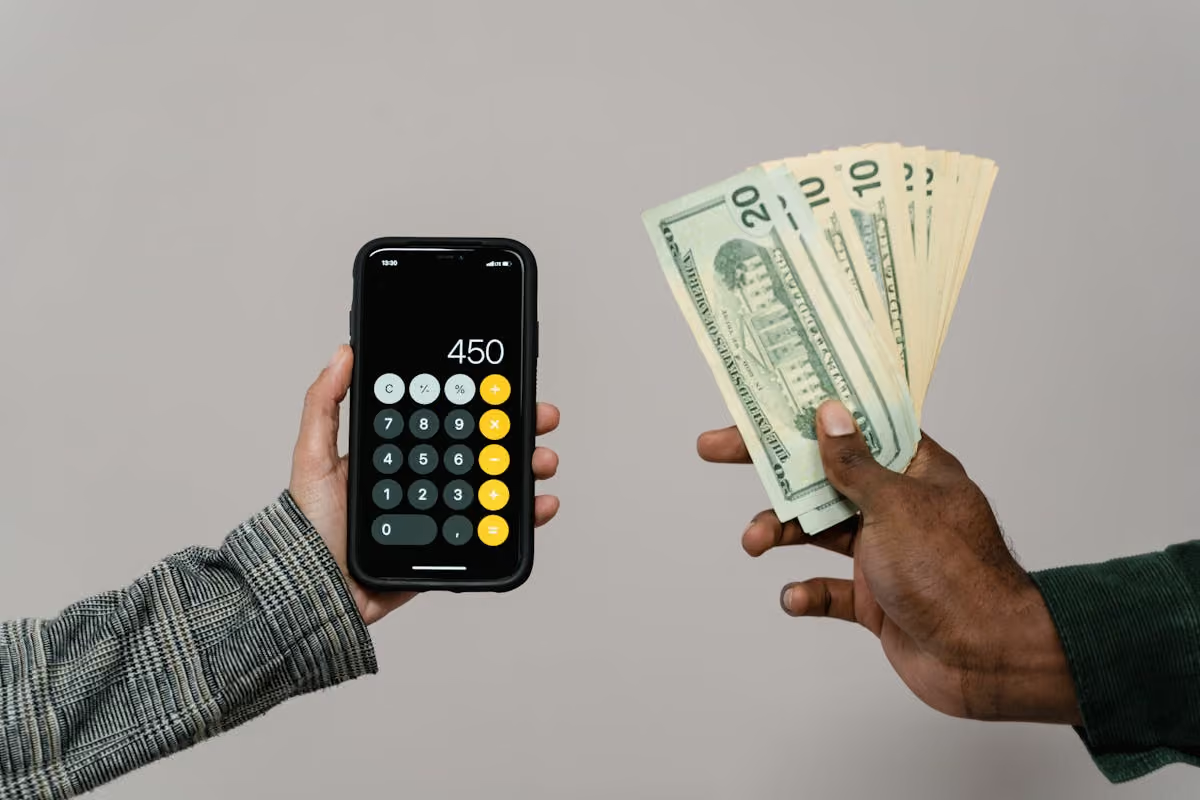
Start free trialAirbnb's commission averages 14 to 16% per booking. Booking.com runs 15 to 25% depending on market and Preferred Partner status. On a host doing 100 bookings a year at €1,500 each, the commission spend is €22,500 to €37,500 every year, recurring forever. A 2025 industry report places direct bookings at 34% of vacation rental volume already and growing. The hosts who shifted that 34% to direct are saving five figures a year on commissions while keeping the guest relationship instead of renting it from the OTA. The math is hard to argue with.
The hard part of direct bookings isn't building a website. It's replacing all the operational glue Airbnb and Booking.com provide for free: payment processing, deposit collection, tax compliance, guest messaging, identity verification, dispute handling. Hosts who underestimate the operational side end up with a direct booking site that converts at 0.5% and chargebacks that wipe out the commission savings. Hosts who overinvest end up with a managed-platform setup that costs more in subscription fees than the commissions it saves. This guide walks through what reliable direct booking infrastructure looks like, the standard tools available at each layer, and the criteria for deciding when direct booking pays back versus when it's a vanity project.
OTA commissions add up fast. The mainstream rates as published by the platforms (Airbnb help article 1857, VRBO help center, Booking.com partner extranet):
A 2025 vacation rental industry report puts the full booking distribution at Airbnb 46%, direct booking sites ~34%, other OTAs and Vrbo and Booking.com making up the rest. The same report found that 57% of hosts cited driving direct bookings as their top 2024 challenge, and roughly 66% set it as a top goal for 2025. Direct bookings also outperform OTA bookings on quality metrics: +45.2% longer stays, +51.3% longer booking windows, and higher ADR.
For a property booking EUR 30,000 per year through Airbnb at a 15.5% host-only fee, that is EUR 4,650 a year going to the OTA. Direct bookings let you keep most of that, minus payment processing (typically 2-3% via Stripe or equivalent) and any direct-booking marketing cost.
A typical direct booking funnel costs USD 50-200 per month in tools (booking engine, payment processor fees, occasional ad spend) and USD 500-2,000 one-time for a custom domain, basic web design, and initial setup. The same 2025 industry report shows that direct bookings are already the second-largest reservation channel for vacation rentals (~34%), so even modest investments compound. The math at portfolio scale:
Add the Google Vacation Rentals tailwind, the same industry report cites a +72% YoY increase in Google Vacation Rentals booking volume: and the case for investing in your direct channel gets stronger every quarter.
Many hosts start with a paid Squarespace or Wix website and a "request to book" form that emails them. The booking flow is:
It works, but it converts poorly (every additional manual step kills conversion) and it does not scale beyond a handful of bookings per month.
Most full property management systems include a direct booking engine. The engine syncs with the same calendar as your OTA channels, accepts payment via Stripe or PayPal, and integrates with your guest messaging templates. The website ranges from a hosted subdomain to a fully custom domain with templates.
Several widgets let you embed a "Book Now" button on any existing website (Squarespace, Wix, WordPress). Useful if you already have a website you like and just need the booking layer.
A separate category focuses specifically on the marketing side: capturing repeat-guest emails, building a brand identity, running promotions to past guests. They typically pair with a booking engine rather than replacing it.
Some smaller OTAs (Airbnb Plus in some markets, Plum Guide for premium properties) take lower commissions in exchange for stricter quality requirements. Useful supplements to your direct funnel; not a replacement.
Mailchimp, Klaviyo, and ConvertKit handle the post-stay sequence: thank-you, review request, off-season repeat-booking discount. Critical for converting first-time guests into direct rebookers.
To match the convenience of an Airbnb booking, your direct funnel has to do five things:
Nowistay includes a built-in direct booking engine that pulls from the same property knowledge base, calendar, and ARI rules as your OTA channels. Payments process through Stripe with automatic deposit and balance scheduling and configurable refund policies. Tax calculation is per-property and per-jurisdiction. Bookings flow through the same automated guest message lifecycle as Airbnb or Booking.com bookings, confirmation, pre-arrival, check-in code (with smart-lock auto-delivery via Nuki, igloohome, TTLock, Tedee, or HomeIt), check-out, review request, all with multilingual auto-translation. The booking page is hosted under your custom domain or a Nowistay subdomain and supports basic branding (logo, colors, photos). Whether you build this through Nowistay, a standalone booking engine paired with a separate PMS, or a custom solution on top of Stripe and your existing website, the criteria above are the test for any setup.
To set up direct booking in Nowistay, see the guides for your website and for manually entered bookings with payment requests: How to set up direct booking on your website ; How to add manual bookings and request payment.
A booking engine without traffic is wasted. Five tactics that work consistently:
Airbnb's terms allow direct booking but prohibit explicitly redirecting guests off Airbnb during an active booking conversation. Practical rules:
Most hosts who launch a direct booking funnel see direct bookings start at 5-10% of total bookings in months 1-3, climbing to 15-25% by month 12 if they actively work the repeat-guest sequence. The first year is mostly building the email list and brand recognition; year two is when the savings really compound. For a 10-property portfolio, the realistic year-one savings are EUR 3,000-6,000; year-two savings can reach EUR 10,000-15,000.
Two scenarios where pushing direct booking is more effort than it is worth:
For everything else, multi-property, brand-driven, repeat-guest-friendly, direct booking is one of the highest-ROI moves a host can make.
The single highest-leverage cohort for direct booking is your past guests. They already know the property, trust you, and need very little reassurance. The conversion sequence that works:
Hosts who run this cycle consistently report repeat-guest direct conversion rates of 15-30% in year two, roughly 5-10x higher than first-time-direct conversion. The repeat-guest channel is also far less marketing-cost-intensive: you are emailing people who already know you.
If you are starting from zero, a realistic 12-month roadmap:
The earliest savings are visible by month 6; the bulk of the benefit lands in year two as the email list compounds.
Sign up free. Repeat-guest sequences, branded booking page, conversion tracking, and the same automated guest messages as OTA bookings. EUR 12/month per property after the trial.
Try Nowistay free

Over 25 years of experience in real estate investing and a recognized expert in short-term rental automation. Bassel helps property managers increase revenue, cut operating costs, and deliver 5-star guest experiences using AI-powered tools he built from firsthand hosting experience.