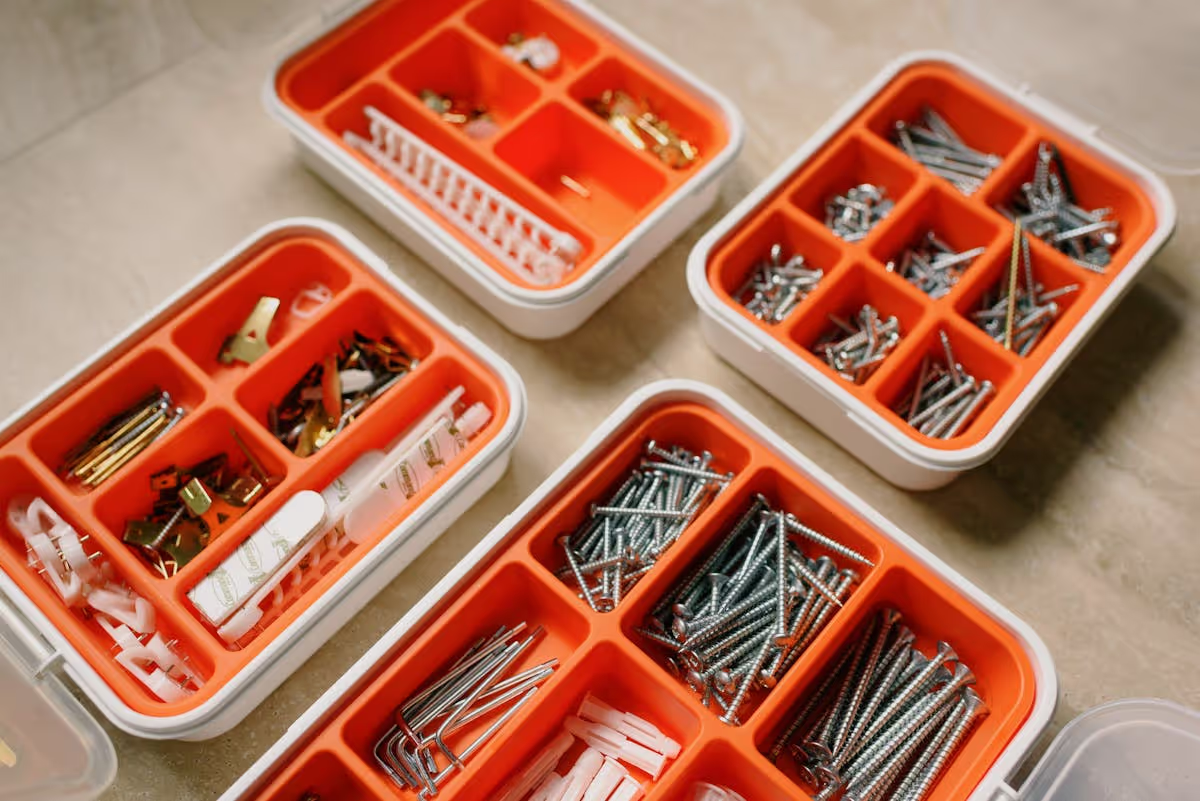
When working in the short-term rental sector, the focus is mainly on Airbnb, Booking, occupancy rates, revenue management... and much less on the inventory checklist. And yet, this simple document could save you from many delicate situations such as disputes, damages, or deposit contests. But is an inventory check mandatory for a seasonal rental? Should you do one regardless? Even if it is not always legally required, adopting the practice of an inventory for short-term rentals is a habit to secure your business. Good news: it's not that complicated to implement, especially with a digital inventory check solution.

AI co-host, channel manager, cleaning automation, smart locks, welcome guide — all at EUR 12/month per property after the trial.
Start free trialThe inventory checklist in seasonal rental is a written document that details each room of a dwelling rented to a traveler, indicating the furniture present and the equipment made available to the tenant travelers. It can also be used to carry out the inventory of the accommodation.
Unlike the inventory checklist performed for a long-term rental lease, the seasonal rental inventory checklist is much more concise. It generally includes:
The inventory checklist can be done upon entry and exit and must be dated and signed by the owner (or their representative, such as an Airbnb concierge service) and the tenant. Both parties are present and can add their observations, each party can add their own remarks.
In the event of observed damage or a deposit deduction, this document will be your reference document to rely on.
The seasonal rental inventory checklist therefore fulfills 3 roles:
While the inventory check is mandatory in the context of long-term rental, it is not mandatory for vacation rental. Clearly, there is no legal obligation to perform an inventory checklist for short-term rentals.
However, in France, the Civil Code establishes a principle of presumption of "good condition" of the accommodation in the absence of an inventory check, via Article 1731.
In practice, this means that without an entry inventory checklist, the tenant is presumed to have received the accommodation in good condition and must return it in the same condition.
On paper, this might seem relatively advantageous for short-term rental professionals. Any damage could legitimately be attributed to the tenant.
In reality, nothing is less certain. This legal ambiguity tends to create a legal no man's land. In case of disagreement, each party will try to prove their version of the facts (photos, email exchanges, Airbnb messages...). And this is where the seasonal rental inventory checklist can defuse the situation, clarify it, and avoid costly and time-consuming disputes.
It is for this reason that the use of an inventory checklist is widely recommended by seasonal rental professionals, even if it is not mandatory.
Imagine you recover a property after your guest's departure. Bad surprise: you notice that the almost-new washing machine, purchased by your owner-client a few months earlier, is unusable.
Without an entry inventory checklist, it's difficult to make a deduction from the security deposit. It's your word against your guest's. The inventory check, signed by your tenant traveler, will allow you to justify any potential deduction from the security deposit and thus avoid prolonged litigious situations.
A complete and documented inventory checklist can serve as proof to your insurers or Airbnb Cover to demonstrate damage and request financial compensation.
By documenting the equipment, its condition, and adding photos, you will have a precise and well-documented inventory check, easily usable in case of a claim.
A precise inventory checklist with photos will help prevent conflicts and frustrations such as:
Since the inventory checklist is signed by the tenant, it will be difficult for them to contest damage not noted upon entry into the accommodation.
It hasn't escaped your notice: seasonal rental is becoming increasingly regulated. Using a well-structured and defined process like the inventory checklist will allow you to highlight your professionalism in this ultra-competitive sector.
Whether on the owner's side or the guest's side, implementing an inventory check for short-term rentals can be a real asset.
A good seasonal rental inventory checklist does not need to be as precise as one for a long-term rental lease. Above all, it must be complete, contradictory (agreed upon by both parties), and signed by both parties. Here is the information to include in your inventory checklist:
For each item or piece of equipment, remember to always add a condition and a photo.
The ideal is to perform an inventory check upon entry and exit. The comparison between these two statuses will justify any deduction from the security deposit.
To put team checks in place in Nowistay, follow the instructions for creating checklists and tracking missions: How to create checklists for your teams (cleaning, etc.) ; Managing Team Tasks ("Missions").
The first solution that comes to mind for performing an inventory checklist is to use a simple printable inventory checklist template and fill it out with the tenant. But limitations quickly arise:
In summary, this is clearly not the right option for managing your seasonal rental inventory checklists on a large scale.
When considering the digitalization of a property management service, some people think of Excel or Google Sheets spreadsheets to manage inventory checklists more easily.
While the Excel or Google Sheets spreadsheet is quite suitable for its customizable and easily modifiable aspect, you will quickly realize that it is unfortunately not the best solution. Managing Excel on a smartphone or tablet is clearly an obstacle course. This solution is not very ergonomic and does not adapt well to mobile devices.
You will also not be able to integrate photos into this type of format, let alone signatures!
Today, the most suitable solution for performing a seasonal rental inventory remains the digital application, on a smartphone or via a web app.
These applications allow you to perform an inventory directly from a smartphone with the possibility of adding photos, comments, having the traveler sign directly...
A vacation rental inventory application like Key To Check for example allows you to easily perform your inventory checks and:
In summary, while the inventory checklist is not mandatory in seasonal rental, it is highly recommended by the majority of sector players. Indeed, it will allow you to:
If done well, this document can become a central piece and a good selling point for both your traveler clients and your owner clients. And thanks to digital tools (like Key to Check, Ziiimo, Check Easy...) you can automate a large part of the process simply and effectively, perfectly aligned with the modern expectations of travelers... and owners.
Free trial, no credit card. Onboard in minutes, scale to 100+ properties.
Try Nowistay free

Over 25 years of experience in real estate investing and a recognized expert in short-term rental automation. Bassel helps property managers increase revenue, cut operating costs, and deliver 5-star guest experiences using AI-powered tools he built from firsthand hosting experience.