Scaling a vacation rental management company is the #1 challenge for concierges and property managers in 2026. Between guest messages at 2 AM, cleaning coordination, and owner reporting, growing your portfolio can feel impossible without growing your team. But AI is changing the equation. This guide shows you how to leverage AI to scale from 10 to 100+ properties without burning out.

Nowistay's AI co-host connects directly to Airbnb and Booking.com to handle 90% of your guest messages automatically. No PMS change required.
Start Free TrialThere is a well-known ceiling in the vacation rental industry. Most property management companies and concierge services stall between 15 and 25 properties. The reason is simple: guest communication scales linearly with your portfolio, but your team does not. Every new property means more check-in questions at midnight, more WiFi password requests, more early arrival negotiations, and more review follow-ups.
According to industry data from 2025 and 2026, guest messaging alone consumes 40 to 60 percent of property management labor costs. For a concierge managing 20 short-term rentals, that translates to roughly 30 to 45 hours per week spent answering repetitive questions: the equivalent of a full-time employee doing nothing but typing replies.
The pattern is predictable. A concierge starts with 5 properties, handles everything personally, and delivers exceptional guest experiences. At 10 properties, they hire a part-time assistant. At 15, the assistant goes full-time. At 20, the concierge faces a critical decision: hire another full-time employee (adding 2,500 to 3,500 euros in monthly costs) or stop growing. Most choose to stop growing, not because they lack ambition, but because the math no longer works.
Consider the daily reality of a 20-property concierge in a tourist city. On an average day, they receive 25 to 40 guest messages across Airbnb and Booking.com. About 70 percent of these are variations of the same 10 questions: What is the WiFi password? Where do I park? How does the washing machine work? Can I check in early? Where is the nearest grocery store? Each message takes 3 to 5 minutes to read, look up the answer, and compose a thoughtful reply. That is 2 to 3 hours daily spent on repetitive tasks that add no strategic value to the business.
This is precisely where artificial intelligence enters the picture. AI does not just help you answer faster. It fundamentally changes the economics of scaling a vacation rental business by decoupling portfolio growth from headcount growth. With AI handling 80 to 90 percent of routine messages, the same team that managed 20 properties can now manage 60, 80, or even 100, without burnout, without hiring, and without sacrificing guest satisfaction.

The term AI is used loosely in the short-term rental industry. Every PMS and channel manager now claims to offer AI features, but the capabilities vary enormously. To be clear about what we mean: AI for vacation rental management refers to systems powered by large language models (LLMs) and natural language processing (NLP) that can understand guest messages, access property-specific information, and generate accurate, human-like responses automatically.
A true AI co-host for vacation rentals goes far beyond simple rule-based automation or template-based autoresponders that have existed for years. The difference is intelligence. An old-school autoresponder sends the same check-in message to every guest at a fixed time. An AI co-host reads a guest message that says "We are arriving by train from Lyon around 3 PM, is there a way to get in early?" and responds with the specific early check-in policy for that property, directions from the train station, and the door code, all personalized and contextually accurate.
AI can handle multi-turn conversations, meaning a guest can ask about early check-in, the WiFi password, and restaurant recommendations in the same message thread, and the AI responds intelligently to each point. It remembers the context from earlier in the conversation, understands implied questions, and knows when to escalate to a human because the situation requires personal judgment.
In 2026, the best AI tools for vacation rental management can achieve 70 to 90 percent automation rates on guest messaging. That means out of every 10 messages your properties receive, only 1 to 3 require human intervention. The rest are handled instantly, 24 hours a day, 7 days a week, in multiple languages. The messages that do reach your team are the ones that genuinely need a human touch: a guest locked out at midnight, a plumbing emergency, a complex complaint, or a special request that requires discretion.
It is worth understanding the three tiers of AI capability currently available in the vacation rental market. The first tier is AI-assisted drafting, where the system suggests a response that a human must review and send. This saves time but does not solve the 24/7 coverage problem. The second tier is semi-autonomous AI, where the system handles straightforward messages automatically but flags anything ambiguous for human review. The third tier is full autopilot AI, where the system manages the entire guest conversation lifecycle with human oversight only for escalated cases. For scaling purposes, only the second and third tiers deliver transformative results.
Guest communication is the single biggest bottleneck preventing property management companies from scaling. AI-powered messaging tools can now handle the vast majority of guest inquiries automatically. This includes pre-booking questions about amenities and policies, check-in and check-out instructions with personalized timing, house rules clarification, local recommendations tailored to guest interests, maintenance requests with automatic team notification, and post-stay review solicitation.
Property managers using AI guest communication report saving 15 to 25 hours per week for portfolios of 20 to 30 properties. More importantly, response times drop from an average of 30 minutes to under 2 minutes, which directly impacts Airbnb Superhost metrics and Booking.com partner score. Airbnb's algorithm rewards hosts who respond within 5 minutes, and AI makes this achievable at any scale.
For concierge services specifically, this means you can take on 30, 50, or even 100 properties without hiring additional guest communication staff. The AI handles routine inquiries while your team focuses on complex situations, owner relations, and business development: the activities that actually grow revenue.
The quality of AI responses in 2026 is remarkably high. Modern AI co-hosts do not sound robotic or generic. They adapt their tone to match the conversation, more formal for a business traveler, warmer for a family on vacation, concise for someone asking a quick question. They include relevant details specific to each property and can even anticipate follow-up questions. A guest asking about parking often also needs to know about the building entrance, so the AI proactively includes both pieces of information.
One of the most underrated advantages of AI in vacation rental management is multilingual capability. If your properties attract international travelers, which most do in popular destinations: you previously needed multilingual staff or expensive translation services. An AI co-host can communicate fluently in dozens of languages, including English, French, Spanish, German, Italian, Portuguese, Dutch, Japanese, and Chinese.
For European property managers and concierge companies operating in tourist destinations like Paris, Barcelona, Lisbon, the French Riviera, or the Italian coast, multilingual AI is a game-changer. A guest from Tokyo can ask a question in Japanese at 3 AM local time, and the AI responds accurately in Japanese within seconds, without any human involvement. A Brazilian family can communicate in Portuguese, a German couple in German, and an American tourist in English, all managed by the same AI system with perfect fluency in each language.
This capability is particularly valuable for concierges managing properties in multilingual markets. Consider a property manager in Nice with listings on both Airbnb and Booking.com. Their guest base might include French domestic travelers, British tourists, Italian visitors from just across the border, German families, and Americans. Without AI, they would need staff fluent in at least 4 languages or accept slower response times while using translation tools. With AI, every guest receives an instant, natural response in their preferred language.
The multilingual advantage extends beyond simple translation. AI understands cultural nuances in communication styles. A Japanese guest might phrase a request more indirectly than an American guest, and a good AI system recognizes and adapts to these differences.
The most efficient way to reduce guest messages is to answer questions before they are asked. AI-powered digital guidebooks and welcome booklets can proactively deliver property information, check-in instructions, local recommendations, and house rules at exactly the right moment in the guest journey.
The key is timing. A digital guidebook sent 3 days before arrival with check-in details prevents the inevitable "How do I get in?" message. A local recommendations guide sent on the morning of arrival prevents dozens of "Where should we eat?" questions. A checkout reminder sent the evening before departure prevents late departures and confused guests.
When combined with an AI messaging system, digital guidebooks create a powerful self-service layer. Guests find what they need in the guidebook, and if they still have questions, the AI handles them. This two-layer approach can reduce human message handling by up to 95 percent across your entire portfolio.
Modern AI-powered guidebooks go beyond static PDFs. They can be interactive, updated in real-time, and personalized based on guest data. If a guest mentioned they are traveling with children, the guidebook can highlight family-friendly restaurants and activities. If they are arriving late, the check-in section emphasizes the self-check-in procedure rather than the key pickup from a neighbor.
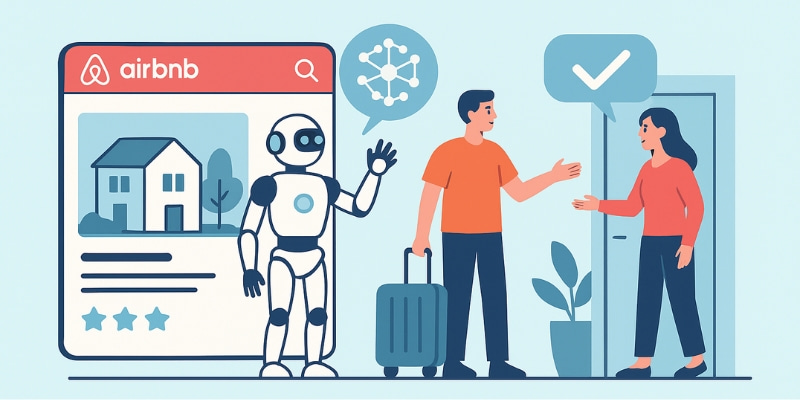
Reviews are the lifeblood of any vacation rental business. A property with a 4.9 rating will outperform an identical property with a 4.6 rating in search results, bookings, and pricing power. AI tools can now automate review solicitation by sending personalized follow-up messages at the optimal time after checkout. They can also draft responses to guest reviews, both positive and negative, maintaining a consistent brand voice while saving property managers hours of work.
For scaling companies, automated review management means maintaining a 4.8+ star average across 50 or 100 properties, not just 10. The consistency that AI provides in review follow-up and response quality is nearly impossible to achieve with a human team managing a large portfolio. When you manage 10 properties, you remember each guest and can write a heartfelt response. When you manage 80, reviews pile up and responses become generic or delayed. AI ensures every guest receives a prompt, personalized acknowledgment.
AI also plays a preventive role in reputation management. By analyzing guest sentiment during the stay, through the tone and content of their messages: AI can flag potential problems before they turn into negative reviews. A guest who mentions the apartment is "a bit cold" can trigger an automatic helpful response about the heating system, potentially preventing a 4-star review from becoming a 3-star one.
To start using the Nowistay AI co-host and understand the information behind its replies, see these guides: How to set up my AI Assistant? ; The AI Assistant’s full knowledge base.
Beyond guest communication, AI is increasingly used to coordinate cleaning schedules, flag maintenance issues mentioned in guest messages, generate owner reports, and even optimize pricing through dynamic rate adjustments. While guest messaging automation delivers the most immediate ROI, these operational AI features compound the scaling advantage over time.
When a guest mentions that the shower pressure seems low, AI can automatically create a maintenance ticket and notify the relevant team member, without any human reading the message first. When a guest checks out, AI can trigger the cleaning team notification with specific instructions based on the property. When an owner asks for a monthly report, AI can compile booking data, revenue figures, guest satisfaction scores, and maintenance logs into a professional document.
The operational layer becomes increasingly important as your portfolio grows beyond 50 properties. At that scale, the difference between a well-coordinated operation and a chaotic one is the difference between profitability and burnout. AI provides the coordination layer that keeps everything running smoothly without requiring you to personally oversee every detail.
Before implementing any AI tool, measure your baseline. How many messages does your team handle per property per month? What percentage are repetitive? What is your average response time? Most property managers discover that 70 to 85 percent of their messages fall into just 10 to 15 categories: WiFi details, check-in procedures, parking information, local restaurants, early arrival requests, late checkout requests, appliance instructions, and similar routine inquiries.
Export a sample of 200 to 300 recent guest conversations and categorize them. You will likely find that a small number of topics generate the majority of messages. This exercise not only justifies the AI investment but also helps you prioritize which information to include in your AI knowledge base first.
Track your response times honestly. Many property managers think they respond within 15 minutes, but data shows the actual average is often 30 to 60 minutes, with significant gaps during nights, early mornings, and busy periods. These gaps directly impact your booking conversion rate and platform rankings.
The vacation rental technology landscape in 2026 offers several approaches to AI integration. You can use an AI tool built into your PMS, a standalone AI platform that connects to your existing channels, or a dedicated AI co-host service like Nowistay that integrates directly with Airbnb and Booking.com without requiring a specific PMS.
The key evaluation criteria should include: automation rate in autopilot mode (not just draft suggestions), accuracy of responses, setup complexity, language support, integration with your existing tools, and pricing structure as you scale. Ask for specific metrics: what percentage of messages does the AI handle without human intervention? What is the accuracy rate? How does the system handle edge cases and escalation?
Request a trial period with real properties, not a demo with curated scenarios. The true test of an AI co-host is how it handles the unexpected: a guest who writes in broken English, a message that combines a complaint with a question, or a request that is technically against your house rules but could be accommodated with flexibility.
AI is only as good as the information it has access to. Create comprehensive property profiles including check-in and check-out procedures, house rules, appliance instructions, WiFi credentials, parking details, local recommendations, emergency contacts, and transportation options. The more detailed your knowledge base, the higher your automation rate will be.
Think of your knowledge base as training a new team member. What would you tell a new employee on their first day managing each property? Write it all down. Include the quirks: the front door that sticks in humid weather, the neighbor who is sensitive to noise, the parking spot that is technically for two cars but only if you park at an angle. These details make the difference between a generic AI response and one that sounds like it comes from someone who knows the property intimately.
Some AI platforms, like Nowistay, can automatically ingest information from your existing Airbnb listings, reducing the setup time from weeks to hours. This is a significant advantage if you manage dozens of properties, as manually creating detailed knowledge bases for each one can be a project in itself.
Do not roll out AI across your entire portfolio at once. Start with 5 to 10 properties that have the highest message volume. Monitor the AI performance for 2 to 4 weeks, reviewing message accuracy, guest satisfaction, and response times. Adjust the knowledge base and settings based on what you observe.
During the pilot phase, review every AI-sent message daily. Look for patterns: are there recurring questions the AI cannot answer? Are there responses that are technically correct but could be more helpful? Is the tone appropriate for your brand? Use this feedback to refine the knowledge base and improve accuracy before scaling.
Pay close attention to escalation patterns. A good AI system should escalate appropriately, not too often (which defeats the purpose) and not too rarely (which risks guest dissatisfaction). The sweet spot for most vacation rental operations is an escalation rate of 10 to 20 percent of total messages.
Once you have validated the AI performance on your pilot properties, roll it out across your entire portfolio. Then redirect the time you have saved toward activities that actually grow your business: acquiring new property owners, optimizing pricing, improving property quality, and building direct booking channels.
This is the most important step, and it is where many property managers fail to capture the full value of AI. They implement AI, enjoy the reduced workload, but do not use the freed-up time strategically. The property managers who truly scale are those who reinvest every hour saved by AI into growth activities. If AI saves you 20 hours per week, that is 20 hours you can spend meeting potential property owners, attending industry events, improving your online presence, or developing partnerships with real estate agents who can refer new clients.
Let us look at the concrete financial impact of implementing AI in a vacation rental management company. Consider a concierge service managing 25 properties, each generating an average of 40 guest messages per month. That is 1,000 messages monthly.
Without AI, a dedicated guest communication agent (costing approximately 2,500 to 3,500 euros per month including employer charges in Europe) handles these messages. With AI automating 80 percent of messages, the same agent can now support 100 to 125 properties, effectively multiplying your capacity by 4 to 5 times without additional hiring.
The math is straightforward: if each property generates 200 to 400 euros in management fees per month, scaling from 25 to 75 properties represents an additional 10,000 to 20,000 euros in monthly recurring revenue, with minimal increase in operational costs. This is the true scaling power of AI in vacation rental management.
Let us break down the full cost comparison. Without AI, managing 75 properties requires approximately 3 full-time guest communication agents at a total cost of 7,500 to 10,500 euros per month. With AI, you need 1 agent plus an AI platform costing 375 to 2,250 euros per month (based on 5 to 30 euros per property). The net savings range from 5,000 to 8,000 euros monthly, while delivering faster response times and more consistent service quality.
The ROI calculation becomes even more compelling when you factor in the indirect benefits. Faster response times increase booking conversion rates by 10 to 20 percent. Better review scores allow you to charge higher nightly rates. Reduced operational stress leads to lower employee turnover. And the ability to accept new properties without hiring creates a virtuous cycle: each additional property is almost pure profit margin once AI handles the communication load.

Even with the best AI tools, property management companies can stumble if they make these common errors.
First, do not set and forget. AI requires ongoing knowledge base updates as properties change, new house rules are introduced, or seasonal information shifts. A restaurant recommendation that was accurate in June might be outdated by October when the restaurant closes for the off-season. Treat your AI like a team member that needs regular briefings. Schedule a monthly review of your knowledge base for each property, and update it whenever something changes.
Second, do not eliminate the human touch entirely. The goal is to automate routine interactions so your team can provide exceptional service for complex situations. A guest having a plumbing emergency at midnight needs a human: the AI should seamlessly escalate these cases. Similarly, a guest celebrating a honeymoon who asks about romantic restaurant recommendations deserves a personal touch that goes beyond what AI can deliver. The best operators use AI to free up time for these high-impact human interactions.
Third, do not choose an AI tool based solely on price. The cheapest option often has the lowest automation rate, which means you still need significant human intervention. A tool that costs 5 euros per property but only automates 50 percent of messages saves far less than one costing 20 euros per property that automates 85 percent. Calculate total cost of ownership including the human time still required, not just the software subscription.
Fourth, do not ignore your existing team during the transition. Train your staff to work alongside AI, reviewing edge cases, improving the knowledge base, and focusing on high-value guest interactions that build loyalty and drive reviews. Employees who fear being replaced by AI will resist the technology. Frame AI as a tool that eliminates the boring parts of their job so they can focus on meaningful work.
Fifth, do not underestimate the importance of testing before scaling. A poor AI response to one guest is a small problem. A poor AI response replicated across 50 properties simultaneously is a reputation crisis. Invest the time in a thorough pilot phase, even if it feels slow. The properties you lose from a botched AI rollout take years to recover.
Property managers often ask whether they should use the AI built into their PMS or opt for a standalone AI solution. Both approaches have merits, and the right choice depends on your specific situation.
PMS-integrated AI offers the advantage of deep integration with your reservation data. The AI can access booking details, guest profiles, and property information directly from your PMS database. However, these tools often operate in draft mode, meaning they suggest responses for human approval rather than sending automatically. This is helpful for reducing composition time but does not fully solve the scaling challenge because it still requires a human in the loop for every message.
Standalone AI co-host platforms (like Nowistay) typically offer higher automation rates in full autopilot mode, connecting directly to Airbnb and Booking.com messaging APIs. They work alongside any PMS, which means you do not need to switch your property management system to benefit from AI. This approach is particularly attractive for concierge services that manage properties across different PMS platforms or that want to keep their existing tech stack intact.
There are also important considerations around vendor lock-in. If your AI is built into your PMS, switching PMS providers means losing your AI setup, conversation history, and trained knowledge base. A standalone AI solution that connects to platforms directly gives you more flexibility to change other parts of your tech stack without disrupting your guest communication automation.
The best approach for many scaling companies is to combine both: use your PMS for operations and channel management, and layer a dedicated AI co-host on top for guest communication automation. This gives you the best of both worlds, operational efficiency from your PMS and maximum automation from a specialized AI tool.
When implementing AI for guest communication, data privacy must be a top priority. Guest messages contain personal information: names, phone numbers, arrival times, and sometimes sensitive details like door codes or personal preferences. Any AI system you deploy must comply with relevant data protection regulations, particularly GDPR for European operations.
Evaluate your AI provider's data handling practices carefully. Where is guest data stored? Who has access to it? Is the data used to train the AI model, and if so, is it anonymized? How long is conversation data retained? These are not just compliance questions: they are trust questions. Your property owners and guests trust you with their information, and that trust extends to any technology partners you use.
Look for AI providers that offer data processing agreements (DPAs), store data in compliant jurisdictions, and have clear data retention and deletion policies. The best providers are transparent about their practices and will proactively address these concerns during the evaluation process.
With effective AI automation handling 80 to 90 percent of guest communication, a single property manager can oversee 50 to 80 properties, compared to the typical 10 to 15 without AI. The exact number depends on property type, guest turnover frequency, and the complexity of your operations. Short-stay urban apartments with high turnover are more communication-intensive than weekly vacation home rentals, so the ratio varies.
No. In fact, most property managers report improved review scores after implementing AI, primarily because response times drop dramatically. Guests receive accurate answers in under 2 minutes instead of waiting 30 minutes to several hours. Speed and accuracy are the two biggest drivers of positive guest communication ratings on Airbnb and Booking.com. The key is ensuring your AI knowledge base is comprehensive and accurate, a fast wrong answer is worse than a slow correct one.
Not necessarily. Many AI solutions, including Nowistay, connect directly to Airbnb and Booking.com without requiring a specific PMS. This means you can add AI-powered guest messaging to your existing workflow regardless of which property management system you use. This flexibility is especially valuable for concierges who manage properties spread across multiple PMS platforms.
Setup time varies by platform. Some AI tools require manual configuration for each property, which can take days or weeks. Others, like Nowistay, can automatically import information from your existing Airbnb listings and be operational within hours. Expect a 2 to 4 week optimization period regardless of platform to fine-tune accuracy and reach peak automation rates.
Yes. Modern AI tools for vacation rentals support dozens of languages natively. This is especially valuable for properties in international tourist destinations where guests may communicate in English, French, Spanish, German, Italian, Portuguese, Japanese, Chinese, Korean, Arabic, and more. The AI detects the guest's language automatically and responds accordingly, with no manual configuration required.
AI co-host solutions for vacation rentals typically range from 5 to 30 euros per property per month, depending on the platform and features. When compared to the cost of hiring additional staff (2,500+ euros per month per employee), AI represents a fraction of the cost while handling a much larger volume of messages. For most property managers, AI pays for itself within the first month through reduced labor costs or the ability to take on additional properties.
The best AI systems are designed to recognize negative sentiment and escalate appropriately. When a guest reports an emergency like a water leak or a lockout, the AI should immediately notify your team while providing the guest with initial guidance. For complaints, AI can acknowledge the issue empathetically and either resolve simple problems (like providing missing information) or escalate to a human for situations requiring judgment or compensation decisions.
No AI system is perfect, and occasional errors will occur. The key is having proper monitoring in place. Most AI platforms provide dashboards where you can review all automated conversations, flag issues, and correct the knowledge base to prevent repeat errors. Over time, the error rate decreases as the knowledge base becomes more comprehensive. Starting with a supervised pilot phase minimizes the risk of errors reaching guests during the critical early period.
The vacation rental industry has reached an inflection point. Over 60 percent of short-term rental operators adopted AI tools in 2025, and among companies managing 50 or more properties, the adoption rate is even higher. Property management companies that do not integrate AI into their operations will find it increasingly difficult to compete on response times, guest satisfaction, and operational efficiency.
The competitive pressure is real. When your competitors respond to guest inquiries in 90 seconds and you take 45 minutes, you lose bookings. When their review scores climb because of consistent, instant communication and yours stagnate, you lose search ranking. When they scale to 100 properties with the same team size and you are stuck at 25, they outpace you in market share and purchasing power with cleaning companies, maintenance providers, and property owners.
The good news is that implementing AI does not require a complete overhaul of your business. Start with guest communication automation: the highest-impact, fastest-ROI application, and expand from there. Whether you are a concierge service managing 10 apartments in Paris or a property management company overseeing 50 vacation homes across multiple cities, AI gives you the tools to scale without proportionally scaling your costs.
The question is no longer whether to adopt AI, but how quickly you can implement it before your competitors do.
Stop answering repetitive guest messages manually. Nowistay's AI co-host automates 90% of guest communication across Airbnb and Booking.com.
Try it free

Over 25 years of experience in real estate investing and a recognized expert in short-term rental automation. Bassel helps property managers increase revenue, cut operating costs, and deliver 5-star guest experiences using AI-powered tools he built from firsthand hosting experience.