A sub-5-minute Airbnb response time requires answering every message, including overnight and in unfamiliar languages, within minutes. IntelliHost data on 5,000+ properties shows sub-1-hour responders convert 25% better and improving from 89% to 100% response rate can lift instant bookings by 116%. This guide explains how Airbnb measures the metric, the verified ranking impact, and a neutral survey of approaches: push notifications + saved replies, virtual assistants, draft-and-review AI co-pilots, and autonomous AI.

Sign up free, connect Airbnb via OAuth, and Nowistay's autonomous AI replies in seconds, 24/7, in 90+ languages. Your 30-day average drops within two weeks.
Start free trialA sub-5-minute average response time over a rolling 30-day window requires reaching every inbound message, including overnight, during meetings, on flights, in languages you don't speak, within minutes of arrival. Most hosts get there with one of three approaches: instant push notifications combined with saved replies, a virtual assistant or co-host service covering off-hours, or an AI tool that responds automatically. Each has trade-offs around cost, reliability, and risk of wrong answers, and at scale most operators combine two or three.
Airbnb's official help articles (article 829 and 430) define two distinct messaging metrics:
For Superhost status, response rate must be 90% or higher when Airbnb evaluates your account quarterly over a 365-day window. The 24-hour-and-30-day calculation can drift quickly with one bad week, but the Superhost evaluation rolls all four quarters into a single qualifying decision four times a year.
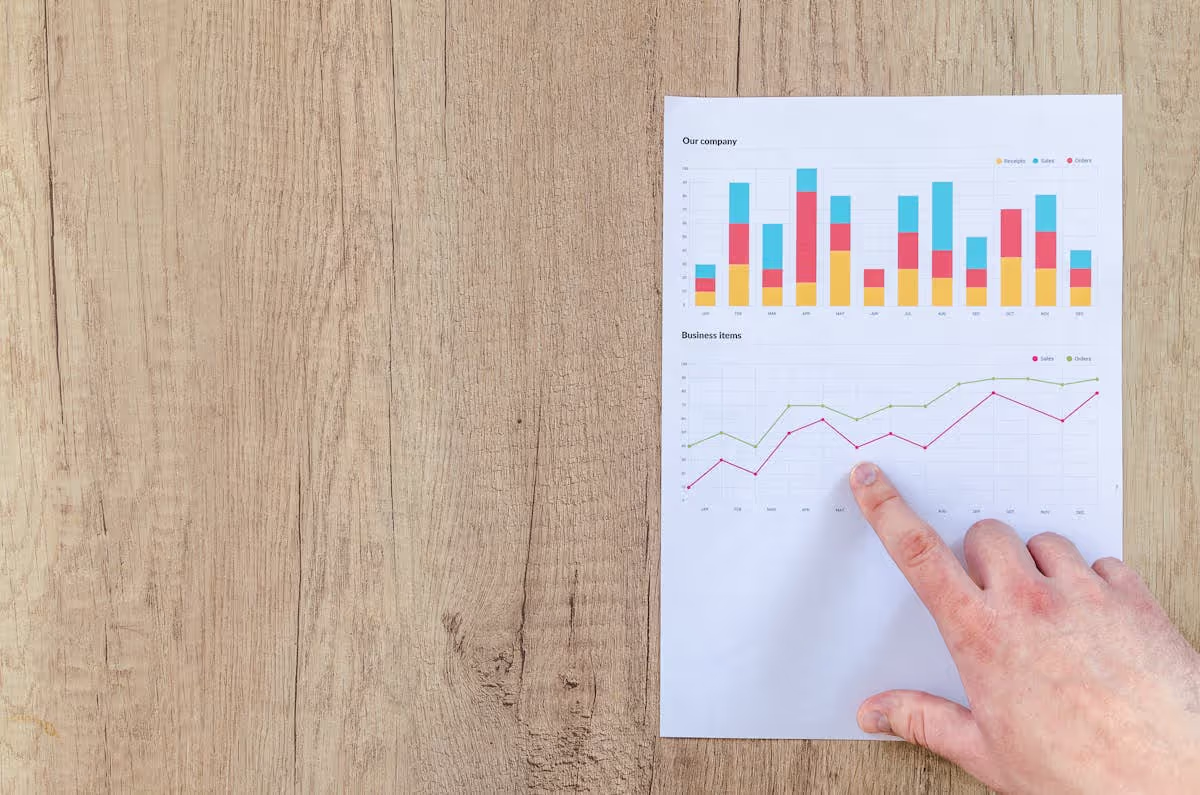
The strongest published data on the conversion impact of response metrics comes from IntelliHost's analysis of more than 5,000 Airbnb properties:
Booking.com tracks an equivalent score behind the scenes that affects your search ranking and Genius / Preferred Partner eligibility. Booking.com's own guidance suggests that achieving 100% Property Page Score can deliver up to 18% more bookings. VRBO (now part of Expedia) reports response time in the partner dashboard but does not publicly display it.
The metric punishes outliers. A single overnight message that takes 8 hours to reply pushes your 30-day average up significantly. To stay under 5 minutes you need to handle:
The math is unforgiving. Fifty bookings per month, five to ten messages per booking, with peak hours skewed to evening and early morning, means 250-500 messages per month. Replying to every single one within 5 minutes is structurally impossible for one human, and even two co-hosts splitting shifts will miss the long-tail (Asian timezones, holidays, sleep gaps).
The starter setup. Install the Airbnb host app, the Booking.com Pulse app, the WhatsApp Business app, enable push notifications, and pre-write 5-10 saved replies for the most common questions (WiFi, check-in time, parking, late check-out, recommendations). When a notification fires, you tap-to-paste the right saved reply. This works for the first 1-3 properties. The failure mode is sleep, even with push, the average is dragged up by messages that arrive between midnight and 8 AM.
For larger portfolios, the standard step is hiring help. Vacation rental VA agencies typically charge USD 400-1200 per month for part-time coverage. Specialized US co-hosts charge a percentage of nightly revenue (typically 10-30%). Both can deliver fast response times during their working hours and slower averages overnight. Quality varies widely, some VAs are excellent, others reply in fragmented English that hurts reviews.
Airbnb lets you configure time-triggered template messages: a welcome message a day before arrival, a check-in code on arrival day, a review request after check-out. These are great for automating proactive communication, but they don't affect response time, because Airbnb only counts your replies to messages the guest sent.
Many full property management systems and guest-messaging platforms offer unified inboxes with smart suggestions. The dominant pattern is a draft-and-review AI co-pilot: the tool reads the inbound message, suggests a reply based on listing details and saved templates, the host taps approve, the message is sent. This reduces typing time per message but still requires the host to be present, so overnight messages still drag the average up unless someone is awake.
A newer category of tools, including Nowistay and a small number of competitor PMS, sends replies automatically without host approval. The AI reads the inbound message, classifies the intent (standard question, complex situation, emergency), and either replies directly or escalates to the host. Sub-5-minute averages are trivial with this pattern because the response goes out in seconds. The trade-off is trust: you have to be confident the AI won't hallucinate or send a wrong answer.
Sole hosts often loop in a partner or family member to cover specific shifts. Free, but only sustainable at 1-3 properties.
Push notifications fail at sleep. VAs are slow at the timezones they don't cover and the cost stacks at scale. Scheduled messages don't count toward response time. Draft-and-review AI co-pilots don't help when you're asleep. Autonomous AI tools work but require building a knowledge base and trusting the system not to hallucinate. In practice, most operators end up combining two or three: an inbox tool with smart drafts during the day, a VA covering evenings, and an autonomous AI for overnight. The friction is in the handoffs.
A reliable target combines these properties:
If your knowledge base is incomplete, an autonomous AI may guess at facts. Mitigation: spend 30-60 minutes per property completing the knowledge base before going autonomous, and review the dashboard daily for the first two weeks.
The AI's default tone may not match yours. Most platforms let you set a tone preference (formal, casual, warm, concise).
Refund requests, special arrangements, complaints, these need human judgment. A well-tuned escalation classifier should send them to the host. Verify yours does.
The mature pattern is to start in draft mode for the first few days, watch what the AI generates, then switch to autonomous once you trust the escalation logic.
Nowistay's autonomous AI co-host covers all six "good" properties out of the box. Every inbound message is automatically sorted into one of three buckets, answer it, ask the host, or emergency, and the AI either replies directly from the property's knowledge base in the guest's language, or it escalates with a short acknowledgement to the guest while a notification reaches the right team member. A separate dashboard tracks response time per channel and per property over rolling windows so you can see the metric improve. Time from a message arriving to a reply going out is typically a few seconds. Hosts switching from manual messaging to autonomous AI usually see their Airbnb 30-day average drop from 1-4 hours to under 5 minutes within two weeks. Whether you reach a sub-5-minute average through Nowistay, a different autonomous platform, or a multi-tool stack with VA coverage, the criteria above are the test for any setup.
To connect your Airbnb listing to the AI co-host and configure the alerts you need, follow these Nowistay guides: How to connect the AI Co-host to my Airbnb listing? ; Manage notifications: push, WhatsApp and email.
Hosts who replace manual messaging with autonomous AI typically report:
Once you're under 5 minutes, the work shifts from getting there to staying there. Three habits help:
Stop losing rankings to slow nights. Free trial, no credit card. EUR 12/month per property after.
Try Nowistay free

Over 25 years of experience in real estate investing and a recognized expert in short-term rental automation. Bassel helps property managers increase revenue, cut operating costs, and deliver 5-star guest experiences using AI-powered tools he built from firsthand hosting experience.