When every gate code, boiler quirk, and guest reply lives only in the host's head, you cannot take a holiday, delegate, or scale, and one sick day breaks the business. This guide shows how to document your operation as standard operating procedures, where to keep them so the team actually uses them, and how to test whether someone else can run the place without you.

Sign up free. Build reusable per-property checklists with photo proof, set guest messages to fire automatically at booking, check-in, and checkout, and let the AI co-host answer guests 24/7 from your welcome guide so the knowledge is not stuck in your head. $12 per property per month after the trial.
Start free trialPicture the Tuesday you wake up with the flu. There is a same-day check-in at 3 p.m., the cleaner texts to ask which unit she is doing first, a guest cannot find the gate code, and the upstairs boiler needs the trick where you hold the reset button for ten seconds or it locks out. None of this is written down. It is all in your head, and your head is currently on a pillow. So you reach for your phone anyway, because the alternative is a one-star review and a refund request, and you run the entire operation from bed because nobody else can.
This is the quiet ceiling almost every host hits. The business works beautifully right up until it depends on you being available, awake, and reachable. You cannot take a real holiday. You cannot hand a unit to a co-host or a cleaner without a forty-minute phone briefing. And you certainly cannot add a fifth property, because the fourth already eats every evening. The fix is not working harder. It is getting the operation out of your head and into a form someone else can follow. That is what standard operating procedures, or SOPs, are for.
An undocumented operation is a single point of failure wearing a clever disguise. As long as you handle every turnover question, every guest reply, and every quirk personally, the quality looks consistent. The moment you are unavailable, the gap shows. A cleaner guesses at your standard and misses the thing you always check. A co-host sends a guest the wrong door code. A maintenance person does not know the water shutoff is behind the false panel in the hall closet. Each of these is a small, avoidable failure that costs a review, a refund, or a frantic hour you did not have.
The cost compounds in three directions. Your time: hosts who keep everything in their heads routinely spend two to four hours a day on tasks a documented system would let someone else handle in minutes. Your ceiling: you cannot scale past the number of units you can personally babysit, which for most solo operators is three to six before burnout. Your exit value: a portfolio that only runs because of you is worth far less to a buyer than one that runs on documented systems, because they are buying a job, not an asset. Writing things down is not admin busywork. It is the difference between owning a business and being owned by one.

Most hosts who tackle this reach for one of a handful of approaches. None is wrong, and the best operations usually blend several. The point is to know what each is good at.
Strip away the tools and a well-documented operation passes a small number of plain tests, whatever software it runs on.
Most SOP advice assumes the procedures live in a separate binder you hope people open. Nowistay's approach is to put the procedure where the work actually happens, so following it is the path of least resistance rather than a discipline. The turnover SOP, the guest-communication SOP, and the property knowledge all live inside the tool the team already touches every day.
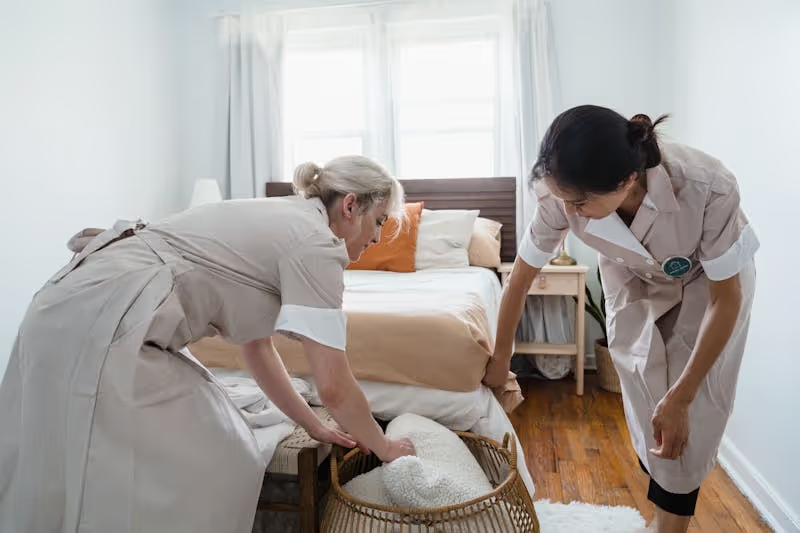
For the turnover, you build reusable cleaning and maintenance checklists per property, and your cleaner completes them with photo proof, so the made bed and the stocked bathroom are documented, not assumed. That is the turnover procedure as a living checklist instead of a laminated card nobody updates. You can set it up in a few minutes following the guide on how to create checklists for your team. Missions for cleaning, maintenance, or urgent jobs route to the right person based on team roles and your chosen assignment mode, so the question "which unit first?" is already answered by the system rather than a text to you.
The guest-communication SOP is the set of messages you send to every guest, captured as templates that fire on their own at booking, check-in, and checkout, so the welcome note and the door instructions go out on time whether or not you remember. Setting that up once is covered in the guide on how to set up automated guest emails, and the same logic extends to WhatsApp and email as first-class channels. On top of the scheduled messages, the autonomous AI co-host answers guest questions in seconds, around the clock, in more than fifteen languages, on Airbnb, Booking.com, WhatsApp, and email, and it sorts inbound messages by urgency so the ones that genuinely need a human get flagged.
The piece that most directly attacks the "it is all in my head" problem is the knowledge base. Your branded digital welcome guide is built per property, and it is part of what the AI co-host draws on, so the boiler trick, the parking rule, and the late-checkout policy you write into the guide once become answers the AI gives guests on its own, 24/7, instead of facts stranded in your memory. When a guest reports a real problem, the AI sorts it into an incident or a request and routes it to the right team member, with a thirty-minute timeout that escalates to you if nobody responds. For your own oversight, the MCP connector lets you connect ChatGPT, Claude, or Gemini to your account and ask, in plain language, what is checking in this week or which missions are still open, and run that as a recurring task. The honest framing: whether you build this in Nowistay or in a stack of docs and a full PMS, the criteria above are the test. Can someone else run it without you?

The dream of a complete operations manual is where most SOP projects die. You block out a weekend, get through the turnover, and never touch it again. Write one procedure for the task that breaks most often when you are away, ship it, and let the next gap tell you what to write next.
You already know the gate sticks and you have to lift it slightly. Your new cleaner does not. Procedures fail at the steps the author assumed were obvious. Write as if the reader has never been to the property and has no idea who you are, then have someone actually unfamiliar try it.
A perfect SOP in a document the cleaner has to log into a separate app to find will not get read. Knowledge has to live where the work already happens: in the schedule they check, the message that fires on its own, the guide the guest already opens.
You change the lockbox code and forget to update the procedure. Now the document is actively lying to the next person. Make updating the procedure part of making the change, not a separate task you will get to later.
A forty-page manual nobody finishes helps no one. Short, skimmable, task-by-task procedures beat one exhaustive tome. If a step can be a checklist item or a thirty-second video, it usually should be.
You do not need a project plan. You need to start with the one thing that would break first if you disappeared, and build from there.
Documenting your operation is not about producing a beautiful manual. It is about buying back your freedom. Every procedure you write is one more thing that can happen without you awake and holding your phone. The goal is not a finished binder; it is a business that keeps running at standard on the Tuesday you have the flu and the year you decide to add three more units. Start with the one task that would break first if you vanished tomorrow, write it down today, and let your own absences tell you what to document next. The day someone else can run the place without calling you is the day you actually own it.
Sign up free. Onboard a property in minutes, assign cleaning and maintenance missions to the right team member by role, and connect ChatGPT, Claude, or Gemini to query your live operation in plain language. Test whether someone else can run the place without you.
Try Nowistay free

Over 25 years of experience in real estate investing and a recognized expert in short-term rental automation. Bassel helps property managers increase revenue, cut operating costs, and deliver 5-star guest experiences using AI-powered tools he built from firsthand hosting experience.